History
According to historians and archeologists, Yahangala Ancient Royal Temple had been a monastic complex. It claims a long history of two-thousand three hundred years. The date of founding goes back to the second half of the third century B.C. The first ruler of the ancient Rohana Kingdom (Southern Sri Lanka), the King Mahānāga, the youngest brother of the King Devānampiyatissa had built this temple. (King Devanampiyatissa’s second brother, the vice-regent named Mahānāga, was dear to his brother- Mahāvamsa XXII-2). So, the initiative age of the temple is belonging to the first phase of Anuradhapura Kingdom, and to the first century from the arrival of Buddhism in Sri Lanka.
To confirm the thesis that Yahangala ancient temple as a construction by the king Mahanaga, we can get light from the Mahavamsa, the great chronicle of Sri Lanka. After describing the arrival of king Mahanaga at the Southern region of the country, the Mahavamsa states that the king had built many ancient temples in the region (Mahavamsa XXII-9). Evidently temple claims a history of two thousand and three hundred years age (2300 years).
New Era
The wera era of the Yahangala temple begins with inhabiting Bandagiriya village in 1956 A.D. Under the former Prime Minister S.W.R.D.Bandaranaike (reign-1956-1959A.D.), Bandagiriya village was established as an agricultural region. The first Chief Incumbent of the temple was Venerable Puhulwelle Sri Seelwansa Maha Thero (1916-1998). He is belonging to the Sri Lanka Ramanna Sect.
After the passing away of Seelawansa Mahathera in 1998, the temple had no a permanent abbot until 2021. In 2021, the Hambantota regional Sangha Council of Sri Lanka Rāmañña Nikāya appointed Venerable Dr. Wadinagala Pannaloka as the permanent abbot.
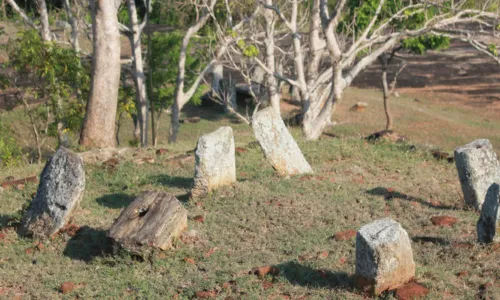
Archeological Ruins and Constructions:
Pot-shaped Pagoda (Ghaṭhākāra Stupa)
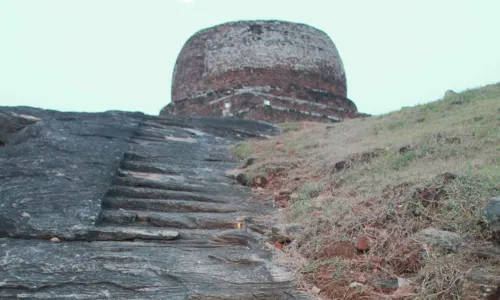
The most important archeological asset in the place is the pot-shaped padoga. It has been renovated in recent times by the Archeological Department of Sri Lanka. However, it remains without decorating with white colour paint. Approximately, the height of the Pagoda is twenty five feet and the diameter is also around 25 feet. A notable feature of this padoda is that its upper part of the structure is built on a stage. The stage has three layers. It is striking to see the pagoda preserves its ancient look. The pagoda can be said as the ‘Centre of Attraction’. It is located o.